
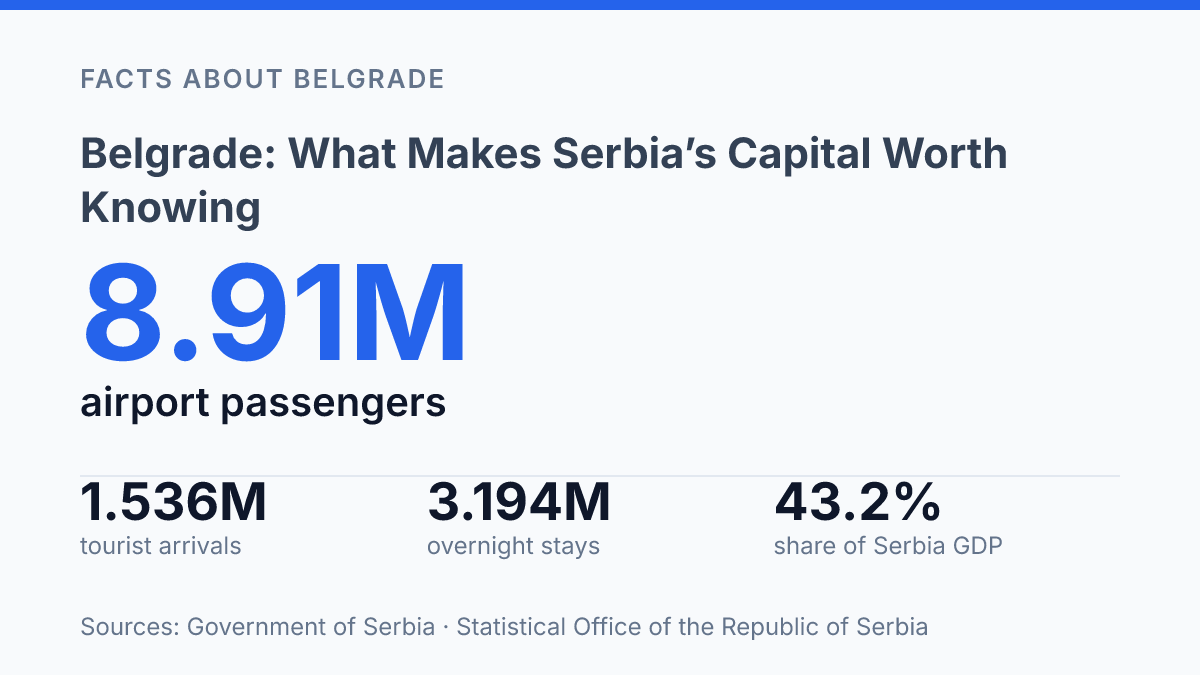
Belgrade handled 8.91 million passengers at Nikola Tesla Airport in 2025. The airport is only one clue to why this city keeps pulling maps toward it. The Serbian capital sits where Corridor X meets the Rhine-Danube route. That sounds like planner language.
It explains a lot. Armies wanted it. Traders needed it. Visitors now use it as a cheap, direct base for the region.
This guide treats Belgrade as more than a weekend stop. It looks at the crossroads beneath the streets, the hard turns from Ottoman control to Austro-Hungarian rebuilding to Serbian rule.
The practical details that shape a first visit. Free public transport from 1 January 2025 changes the rhythm, too. In my honest opinion, that policy makes the city easier to read, not just easier to cross.
Why Belgrade sits at a strategic crossroads
Belgrade is one of the rare European capitals whose map reads like a strategic diagram: two great rivers, a defensive ridge, and routes pulling in from both halves of the continent. The Sava meets the Danube here, right near the line where Central Europe gives way to Southeast Europe.
That confluence didn’t just make the city picturesque. It made the place useful.
Goods could move by water deep into the continent, then connect with roads heading south and east. The same geography worked for armies, tax collectors, merchants, and rulers.
Serbia still describes itself as sitting on Corridor X and the Rhine-Danube river corridor, with 1,677 km of inland waterways, according to the Government of Serbia. That modern transport language has old roots.
The hard edge of that advantage is easy to see at Belgrade Fortress. From its position above the river meeting point, it watched over vessels below and land approaches behind it. Control the height.
You could control movement. Control movement. You could shape trade, defense, and political power.
But the same position that made the Serbian capital rich in influence made it exposed. A city placed between regions doesn’t get to stay neutral for long.
It attracts money, attention, and pressure. The fortress falling to the Ottomans in 1521, noted by the city’s official sights page, captures the pattern without needing a full battle-by-battle history.
In my view, the river junction is the city’s real master key, not a scenic backdrop. If you want to understand why this capital kept mattering to empires, states, and traders, start with the map. The answer is right where the waters meet.
Belgrade’s layered history in a few sharp turns
The city has been destroyed and rebuilt more than 40 times, so its past reads less like a neat timeline than a survival habit. That roughness matters. The Serbian capital doesn’t look polished in one grand imperial style because no single power held it long enough to make the whole place obey one design.
Its early urban story starts with Singidunum, the Roman settlement that put stone, roads, camps, and imperial order onto an older strategic site. Rome left a grid-like idea of control behind, but not a frozen museum piece.
Later centuries kept overwriting it. You can feel that in the city’s mix of fragments, where classical traces sit far beneath streets shaped by much newer ambitions.
Ottoman rule pushed the city toward the rhythms of an eastern frontier town. Habsburg control pulled it back toward Central European military planning, Catholic influence, and baroque urban habits. Neither layer erased the other.
That’s the point. The city kept changing hands, but each period left marks in street patterns, religious sites, military works. The plain fact that rebuilding became normal.
The sharp modern turn came in 1878, when Serbia gained international recognition of independence at the Congress of Berlin. That date didn’t magically smooth the city into a national showcase. It opened a harder task: turning a battered border city into the capital of a modern state.
New institutions rose, older quarters changed. The city started projecting confidence even as scars remained close to the surface.
This is the central contrast: the city’s biggest strengths came from repeated destruction… and that’s what gives it so much character now. Ruin forced adaptation.
Foreign rule brought unwanted pressure. It also left cultural layers that still refuse to line up neatly. In my honest opinion, that unfinished quality is the real historical signature, not a flaw to explain away.
What to know before you visit the city
The easiest mistake is assuming a walkable center means a small city. The urban area holds about 1.2 million people, so distances start to matter once you leave the core. You can cover a lot on foot, but not the whole place.
A first visit usually orbits three landmarks. Knez Mihailova gives you the main pedestrian spine, lined with shops, cafés, galleries, and grand facades. Kalemegdan is the place to slow down rather than rush through. Treat it as a park, viewpoint, and historic complex in one.
St. Sava Temple sits outside that immediate pedestrian loop, and that’s the point. Its scale changes how you read the city.
The interior feels monumental. The surrounding streets remind you that daily life keeps moving around the showpiece.
The older central districts feel compact, especially around Stari Grad, Dorćol, Vračar, and Savamala. Across the river, Novi Beograd works differently.
It has wider roads, larger blocks, postwar planning, business zones, apartment towers. A rhythm that can feel more spread out than the old center.
That contrast can trip up first-time visitors. A map makes everything look close, but one extra stop can turn a casual stroll into a long crossing. In my humble opinion, the smartest way to understand the city is to walk the old core, then deliberately spend time in Novi Beograd so you don’t mistake the center for the whole capital.
One practical detail helps: from 1 January 2025, public transport became free across city and suburban buses, trams, trolleybuses, and BG Train, according to the Tourist Organization of the city. That removes a small barrier for visitors. Still, free doesn’t mean instant, so plan by area rather than trying to tick off scattered sights in one sweep.
Why the city matters beyond sightseeing
A city that houses the National Assembly also supplies Serbia with many of the crowds that challenge it. Belgrade is Serbia’s capital, so national power is concentrated here: the presidency, parliament and government ministries shape decisions that reach far beyond city limits. Embassies and major media keep the same pressure close to the center.
That concentration gives the city status. It also makes it impatient. The Serbian capital is both the political center and the most restless one.
That mix gives it energy. It also keeps expectations high. In my view, that impatience is exactly why the city matters.
Serbia’s wider transport position is not just map logic. The country’s claim to sit on two major European corridors becomes tangible in the capital’s airport traffic: government infrastructure data says Belgrade Nikola Tesla Airport handled 8.91 million passengers in 2025, up 6.5% on the previous year. That kind of movement changes the city’s role from administrative seat to regional meeting point.
Culture gives that power a public face. The Nikola Tesla Museum does more than preserve objects connected to a famous inventor. It turns science, memory and national identity into something visitors can read in one compact institution.
Money adds another layer. Preliminary 2024 regional accounts put the capital region at 43.2% of Serbia’s GDP, so debates about housing, wages and development here don’t stay local for long.
The city pulls ambition toward itself. That pull creates resentment too.
That is the real point beyond sightseeing. The city matters because it concentrates authority, culture, money and argument in one place.
You don’t just pass through it. You feel how Serbia negotiates with itself.
Why the machinery matters more than the postcard
The smartest next step is not another monument. Ride the free network that began on 1 January 2025, then watch where people change lines, buy coffee, and disappear into side streets.
A capital that produces 43.2% of Serbia’s GDP will never be just a museum. It sells, argues, builds, and absorbs newcomers fast.
That creates the city’s real tension. The same place tied to Corridor X and river traffic can feel blunt at street level. Service can be uneven.
Beauty can arrive without polish. In my humble opinion, that friction is the point, not a flaw. If you come looking only for charm, you’ll miss the machinery. If you follow the movement, the city starts making sense.
Frequently Asked Questions
Q: What is Belgrade best known for?
A: Belgrade is best known for its mix of old fortifications, riverfront energy. A nightlife scene that runs late. Kalemegdan is the name most visitors learn first, and 3 main riverside zones tend to shape how people experience the city. In my view, that’s what makes it feel less polished than other capitals, but far more alive.
Q: Is Belgrade safe for tourists?
A: Yes, most visitors get around without trouble if they use normal city sense. Pickpocketing can happen in crowded places, so keep an eye on your bag and don’t flash valuables. The city feels relaxed during the day, but late-night areas need a little more awareness.
Q: How many days do you need in Belgrade?
A: Two full days is enough for a quick first look, but three days feels better. That gives you time for the center, the river area, and one slower stretch of the city. If you only stay one night, you’ll miss the part that makes the place stick with you.
Q: What should I eat or drink in Belgrade?
A: Start with grilled meat, pastries, and strong coffee. Rakija also comes up fast, especially in local bars and family-run spots. The food is simple on paper. The experience is better when you eat where locals actually go.
Q: Is Belgrade expensive to visit?
A: No, not by most European capital standards. A meal, a taxi ride. A basic hotel usually cost less than they do in Western Europe, though trendy riverfront spots can push prices up. That mix is useful… you can spend carefully or go a bit heavier without the bill turning ugly.