
The question “Why is Belgrade called White City?” has an unusually firm starting point: Beograd, or Beli Grad, appears in a letter dated 16 April 878 from Pope John VIII to Bulgarian prince Boris. That record makes the name more than a later travel phrase, while the city’s setting explains why it was persuasive. Official fortress histories connect Beli Grad with white limestone, early Byzantine stonework, and the ridge above the meeting of the Sava and Danube, where fortifications could be seen from a strategic river junction.
The article examines how language, stone, and topography converged around a site whose settlement history reaches far beyond the medieval Slavic name. It also separates the documentary evidence from looser nickname explanations, showing how an ancient fortified hill still shapes the way Serbia’s capital presents itself.
The meaning behind the name Belgrade
A papal letter dated 16 April 878 is the earliest known document to preserve the Slavic name behind Belgrade’s “White City” identity, according to the Belgrade Fortress official site. That makes the explanation more than a later romantic label: the name was already being recorded in early medieval diplomatic writing. The same source links the form Beli Grad to the meaning “White City,” giving the English phrase a documentary and linguistic basis rather than treating it as a loose nickname.
The Serbian name Beograd supplies the direct source of the English translation. Its Slavic elements are simple: “beo” or “bel” means white, while “grad” means city, town, or fortified settlement. In this sense, “Belgrade” is not an English invention but an adapted form of the local name, carrying across the same basic meaning from Serbian into other languages.
What remains less simple is the reason the color white became attached to the place in the first place. Historical explanations usually connect the wording to visible features of the old fortified settlement, but the name itself does not preserve a full description of why medieval observers chose that color term. This creates a useful distinction: the translation of the name is clear, while the original visual or symbolic trigger is interpreted through later historical, archaeological, and topographical evidence.
The endurance of the name is also part of its significance. Across medieval usage, the Ottoman period, and the modern Serbian form, variations of Belgrade or Beograd continued to identify the same strategic urban site even as languages of administration and power changed. The continuity of the name helped keep the “White City” meaning attached to the place through very different historical periods without requiring a single uninterrupted political story.
White limestone, old fortifications, and the Danube-Sava confluence
From the hill above the river junction, pale masonry could be seen before anyone reached the gates. Belgrade Fortress occupies the high ground where the Sava meets the Danube, a position that made the settlement visible from river approaches as well as from the surrounding lowlands. The Tourist Organisation of Belgrade describes the fortress as a structure built and rebuilt from the 1st to the 18th century, which helps explain why the site preserves layers from several political and military periods rather than a single construction phase.
Parts of the old fortifications used white or light-colored limestone, and official fortress interpretation links the “white” idea to the pale limestone ridge and early stone defenses. This does not mean the color of the walls provides a complete explanation on its own. It gives the name a credible visual anchor: a light-toned fortified settlement standing on a prominent ridge above two major rivers would have been a memorable landmark, especially in a region where fortified towns were often identified by visible physical traits.
The confluence also explains why the site mattered militarily for so long. Roman Singidunum controlled routes along the Danube frontier, while later Byzantine, Hungarian, and Ottoman authorities treated the same hilltop fortress as a defensive and administrative prize. Each period altered the fortifications to suit new weapons, borders, and political needs, leaving a compact record of imperial rivalry in stone.
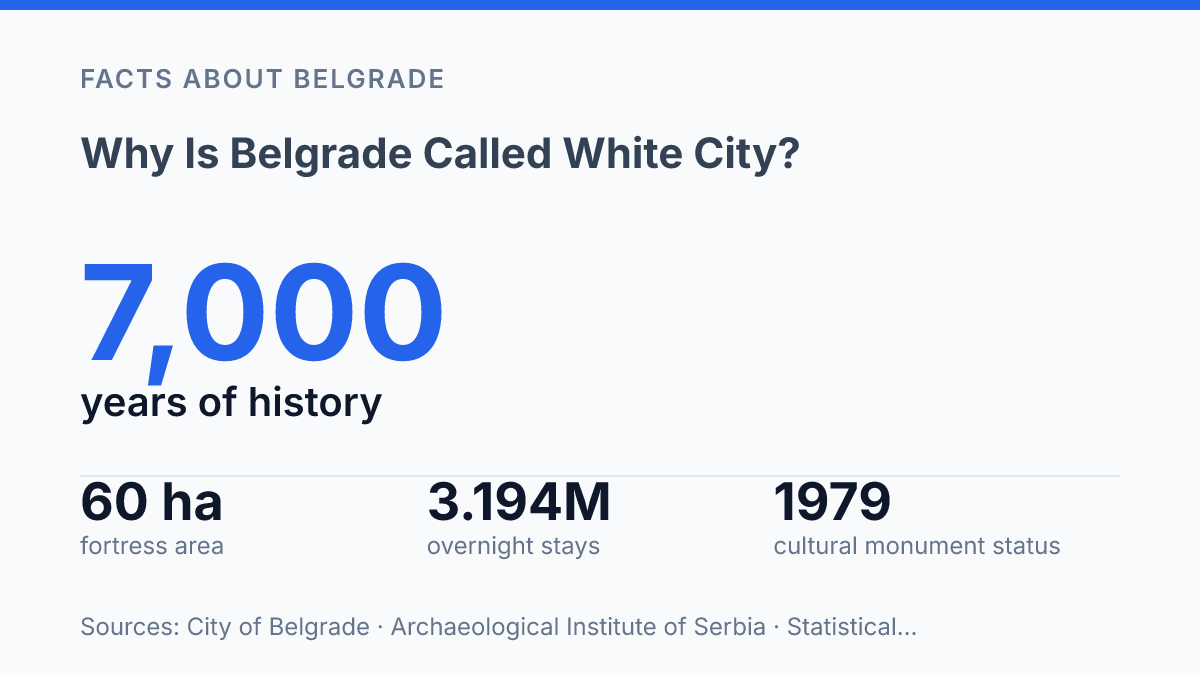
Scale reinforces the point. The Archaeological Institute of Serbia describes the fortress complex as a layered cultural monument covering nearly 60 hectares in the center of the modern city. A site of that size, placed above one of southeastern Europe’s major river junctions and built partly from pale stone, supplies a strong physical basis for the White City association, even if the full naming history also belongs to broader medieval naming habits and inherited local memory.
How historians explain the nickname
The firmest historical evidence explains the name more securely than it explains the original visual trigger behind it. Medieval chroniclers and administrative writers preserved forms of the city’s name that point to a “white fort” or “white city,” but their references were usually concerned with power, borders, campaigns, and church jurisdiction rather than with giving an architectural description. That makes the translation relatively stable while leaving the motive for the colour term partly open.
A useful distinction is between literal meaning and retrospective explanation. The literal translation rests on language: the inherited place-name contains a colour word and a word for a fortified settlement or town.
A retrospective explanation asks why that colour word was chosen, and that is where historians have to work with less direct evidence. Some accounts and later summaries connect the whiteness to pale masonry or the exposed fortress above the rivers; others treat “white” as part of an older naming convention whose exact origin cannot be reconstructed with certainty.
Later travelers added a second layer of testimony because they often described what the city and fortress looked like after major phases of repair. Ottoman, Habsburg, and other early modern observers, including Evliya Çelebi, wrote about Belgrade as a fortified place of strategic and visual prominence, but such descriptions do not necessarily record the conditions that existed when the Slavic name first took hold. They are valuable because they show how the city appeared to outsiders in later centuries, not because they can by themselves prove the first reason for the nickname.
Repeated siege damage is one reason the evidence remains uneven. Walls, gates, towers, and facing stones were repaired, demolished, rebuilt, and adapted across successive military regimes, so the surviving fabric is a layered record rather than a single medieval snapshot.
Formal archaeological investigation of the fortress began in 1936, according to the Archaeological Institute of Serbia, and this research history matters because material evidence can identify building phases, reused stone, and later reconstruction. It also limits overconfident claims: pale stone may explain much of the visual association, but the exact balance between material appearance, written naming practice, and later storytelling cannot be reduced to one documented moment.
What the name means for Belgrade today
A name recorded in the ninth century now appears on maps, museum panels, tourist guides, municipal materials, and English-language explanations of the Serbian capital. In official Serbian use, the city is Beograd, while “White City” usually appears as an explanatory translation for international audiences rather than as the city’s formal English name. The documentary anchor remains the record that the Slavic name Belgrade/Beograd first appears on 16 April 878 in a letter from Pope John VIII to Bulgarian prince Boris, according to the Belgrade Fortress official site.
Belgrade Fortress gives the name its most visible contemporary setting. The site is not only a historical reference point but also a public heritage space integrated with Kalemegdan Park, where residents and visitors encounter the city’s older layers through walls, gates, viewpoints, exhibitions, and commemorative markers.
Its protected status reinforces this role: the fortress and park were placed under protection in 1946 and declared a cultural monument of exceptional significance in 1979. That designation keeps the historical core behind the name within the civic fabric rather than isolating it as a distant medieval reference.
Tourism material commonly uses the “White City” idea because it is short, memorable, and easy to connect with the fortress, the rivers, and the older urban core. The phrase also appears in cultural references, travel writing, event promotion, and informal descriptions of Belgrade, where it can signal continuity between the modern capital and its long-recorded name. Serbia’s Statistical Office reported 3.194 million tourist overnight stays in Belgrade in 2024, the highest figure among individual tourist towns and places in Serbia, giving these heritage explanations a large contemporary audience.
The modern meaning of the nickname is therefore civic as much as descriptive. It helps package a complex past in language that is understandable across Serbian and English contexts, but its authority still comes mainly from history, topography, and preserved monuments rather than from branding alone. That distinction matters because the phrase remains strongest when it points back to the city’s documented name and enduring fortress setting, not when treated as a free-standing promotional label.
Why the name still carries civic weight
A historic nickname retains force when it remains visible, protected, and economically relevant. Belgrade’s old core is not an abstract origin story: the fortress and Kalemegdan were placed under protection in 1946, later recognised as a cultural monument of exceptional significance in 1979, and still anchor the city’s public image.
That matters in a capital that recorded 3.194 million tourist overnight stays in 2024, more than any individual tourist town or place in Serbia. The phrase White City now works as a bridge between evidence and identity, turning a medieval description of stone and position into a modern reference point for heritage, tourism, and civic memory.
Frequently Asked Questions
Q: Why is Belgrade called White City?
A: The name comes from the Slavic words for white and city, reflecting an early place name rather than a modern nickname. Historical explanations usually connect it to the pale limestone and bright fortifications seen along the rivers. The name has persisted because it was recorded early and remained tied to the city’s identity.
Q: What does the name Belgrade mean in Serbian?
A: In Serbian, Beograd literally means “white city.” The form combines belo, meaning white, and grad, meaning city or town. That meaning is the basis for the English phrase used in references to the city’s name.
Q: Was Belgrade ever named differently?
A: Yes, the settlement had earlier names under different periods of rule and language use. Ancient and medieval sources refer to the area with names that reflected local, Roman, Byzantine, and Hungarian influence. The current name became established later and remained the standard form.
Q: Is Belgrade called White City because of the fortress walls?
A: That is one of the most common explanations. The city’s fortifications and riverside stone structures could appear light in sunlight, which fits the “white” description. Historians usually treat this as a plausible origin rather than the only possible one.
Q: Is Belgrade the only city with a name meaning White City?
A: No, several places in Slavic languages and related traditions have names that mean “white city” or use similar color-based descriptions. Such names often developed from visible landmarks, defensive walls, or older settlement naming patterns. Belgrade is one of the best-known examples because the meaning remained transparent in the modern language.