
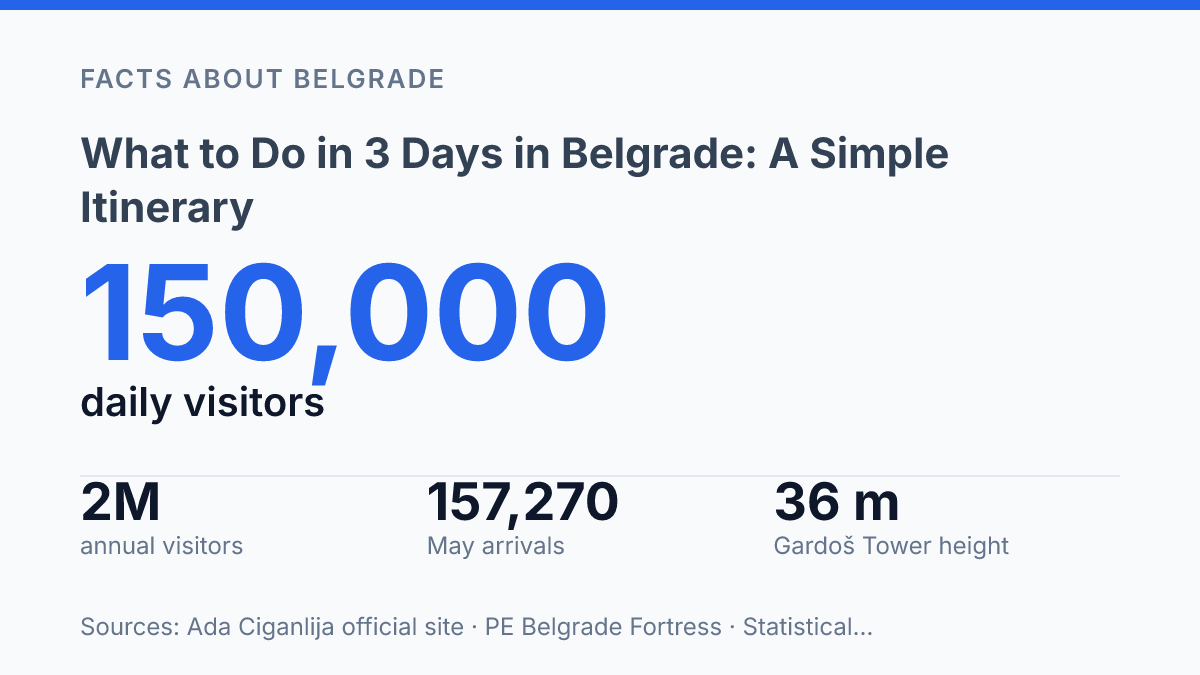
If you’re asking “What to do in 3 days in Belgrade?”, the timing now works in your favor: since January 1, 2025, the city’s buses, trams, trolleybuses, BG Train, and suburban routes have been free to ride. That changes the feel of a short trip. You can move between the fortress, the old pedestrian streets, Zemun, museums, and the river without treating every transfer like a cost-benefit calculation. Belgrade is busy, too, with 157,270 tourist arrivals recorded in May 2026, but it still suits a simple three-day plan if you give the big places enough room.
Kalemegdan alone covers more than 60 hectares, so rushing through it would be a waste. The trick is not seeing everything. It’s choosing the right mix of history, food, river time, and one flexible escape route when the city starts pulling you in different directions.
Day 1: Kalemegdan, Knez Mihailova, and the Old Town
From Kalemegdan, you can watch the Sava and Danube meet before you’ve bought a museum ticket, booked a tour, or figured out the tram map. That’s why it makes sense to start your first day at Kalemegdan Fortress, then let the route naturally pull you back toward the old center.
Give the fortress and park proper time rather than treating them as a quick viewpoint. Walk the walls, pause at the river overlooks, and leave space to wander the paths around the military displays, gates, and shaded edges of the park. The confluence view is the big reward, but the area is also useful because it helps you understand the city’s shape: rivers below, old streets behind you, and the main pedestrian zone just a short walk away.
From Kalemegdan, head into Knez Mihailova Street, Belgrade’s main pedestrian strip for shopping, cafés, street musicians, and slow people-watching. It’s polished and central, but not just a mall-like street; it works as the easiest connector between the fortress and the historic center. If you want a coffee break, this is the simplest place to take it without pulling yourself off the route.
The walk naturally ends around Republic Square, where you’ll find the National Museum and some of the city’s most familiar meeting points. This part can feel busy, especially late afternoon and early evening, so don’t judge the whole Old Town by the densest few corners. Belgrade has been drawing more visitors, too: in May 2026, the city recorded 157,270 tourist arrivals and 376,688 overnight stays, according to the Statistical Office of the Republic of Serbia.
If crowds build around the square or the fortress viewpoints, the fix is simple: shift your pace rather than your plan. Start at Kalemegdan in the morning, use Knez Mihailova as a relaxed midday stroll, and leave Republic Square for a short look instead of trying to make it the whole afternoon. You’ll cover the classic core without turning day one into a checklist.
Day 2: Zemun, riverside walks, and local food
A 36 metres-high lookout from 1896 gives Zemun a very different payoff from the first day: wide Danube views instead of dense city-center sightseeing. Gardoš Tower, also known as the Millennium Tower, is the obvious place to aim for first, partly because the climb up through Zemun’s quieter streets makes the view feel earned. The Municipality of Zemun lists the tower as 36 metres high, and from the area around it you get one of the best Danube-facing perspectives in this part of Belgrade.
Give yourself time here rather than treating Zemun as a quick detour. It’s calmer than the center, which is exactly the appeal, but the trip there and back can take longer than first-time visitors expect. Belgrade’s public transport is free on city and suburban buses, trams, trolleybuses, and BG Train, according to the Tourist Organization of Belgrade, so cost isn’t the issue; it’s more about allowing enough time for the ride, the walk uphill, and a relaxed meal afterward.
After the tower, head down toward the Zemun quay for the easiest part of the day. The riverside promenade is made for unhurried walking, with benches, riverboats, cafés, and long stretches where you can just follow the Danube without needing a strict plan. If the weather is good, this is a nice place to slow the itinerary down and let the day feel less like a checklist.
For food, keep it simple and local. Zemun is a good area to sit down for ćevapi, order a pljeskavica, or choose a traditional kafana meal with grilled meat, salads, bread, and something hearty from the daily menu.
You don’t need a polished fine-dining stop for this day to work. The point is to eat well, linger a little, and see a neighborhood that feels more lived-in than the main tourist streets.
Day 3: Museums, Ada Ciganlija, or a fast escape from the city
A 45-minute English tour at the Nikola Tesla Museum can still leave you enough daylight for a lake break or an easy trip beyond Belgrade. In 2026, the museum listed its English guided tour at 800 RSD, starting hourly and payable in cash only, according to the Nikola Tesla Museum. That makes it one of the easiest indoor choices to slot into a final day, especially if the weather turns or you want something structured without giving up the whole afternoon.
If you’re more interested in history than science, choose the Museum of Yugoslavia instead. It’s the better pick for understanding the country that shaped much of the 20th-century background behind modern Serbia, and it gives the day a slower, more reflective feel. Don’t try to squeeze both museums in unless you’re deliberately making this a culture-heavy day; one good museum visit is usually enough before lunch or a late-afternoon reset.
For fresh air, make Ada Ciganlija your main target. The lake area is built for an easy half-day: walking, cycling, sitting by the water, or swimming in warm months.
Ada Ciganlija’s Sava Lake has about 6 km of man-made beaches and can receive up to 150,000 visitors per day during the summer bathing season, according to Ada Ciganlija’s official site, so an earlier start is smarter if you’re visiting on a hot weekend. The same source says 99.8% of water samples over the previous five years met first- or second-category surface-water standards, which is useful to know if you’re considering a swim rather than just a walk.
If you’d rather leave the city for the day, keep the plan simple. Novi Sad is the natural choice for a compact city escape, with enough cafés, architecture, and sightseeing to feel different without turning the day into a marathon. Topola works better if you’re drawn to wine country and royal history around Oplenac, though it needs a little more planning than a casual urban side trip.
The key is to choose one lane, not all of them. Bad weather points you toward a museum, sun points you toward Ada, and extra energy makes a short trip out of Belgrade feel worthwhile.
How to fit the trip together without rushing
The easiest way to ruin a Belgrade three-day plan is to trust the map more than the traffic. Distances can look modest, but crossing between central Belgrade, Zemun, and Ada Ciganlija can take longer than expected once you factor in one-way streets, bridges, waiting time, and evening congestion.
Use walking for the compact central parts, especially if you’re staying around Stari Grad, Dorćol, or Savamala. Those areas keep you close to the old center, the riverfront, restaurants, and easy onward transport, so you don’t start every day with a long transfer. Dorćol works well if you want a quieter neighborhood feel, while Savamala is handy for river access and nightlife.
For longer hops, public buses are useful, especially when you’re heading toward Zemun or Ada Ciganlija. Taxis can save time when you’re tired, traveling late, or trying to connect two places that don’t line up neatly by bus. Just give yourself a buffer rather than planning every transfer to the minute, because a 15-minute ride on paper can stretch during rush hour.
The pacing works best if you think in half-days rather than hourly blocks. Kalemegdan is worth two to three hours at a comfortable pace, and more if you like slow viewpoints and lingering walks; the wider Belgrade Fortress–Kalemegdan complex covers over 60 hectares, according to PE “Belgrade Fortress,” so treating it as a quick stop is usually too optimistic. Zemun also fits best as a half-day, especially if you’re including time by the river and a relaxed meal.
Ada Ciganlija is the one to keep loose. You can visit for a short walk or coffee, but if the weather is good, it easily becomes a half-day break rather than a quick detour. That’s not a problem; it just means you shouldn’t stack it with several cross-city plans afterward.
A simple rhythm is one main area per day, one optional add-on, and one unplanned pause. Belgrade is very doable in three days, but it rewards a little breathing room more than a checklist approach.
Why the gaps in the itinerary matter
Belgrade rewards a loose plan more than a packed checklist. Before you lock in each hour, choose one fixed point per day, then let the free transport fill in the gaps. That might mean staying longer in Zemun because the riverfront feels right, or swapping a museum slot for Ada Ciganlija if the weather turns hot.
The practical win is simple: you don’t need to treat distance as a penalty here. With no ticket cost on city transport, the smartest three-day route is the one that leaves space for small decisions, because those are often what make Belgrade feel less like a stopover and more like a city you started to understand.
Frequently Asked Questions
Q: Is 3 days enough to see Belgrade?
A: Yes, three days is enough to cover Belgrade’s main sights and get a feel for the city. You can comfortably fit in the historic center, a few major neighborhoods, and some time for food or a river walk. If you like moving slowly, you may want a little extra time, but three days works well for a first visit.
Q: What should I prioritize on a first trip to Belgrade?
A: Start with the city’s old center, then add one or two areas that show a different side of the city, like the riverside or a local neighborhood. That gives you a mix of history, everyday life, and places to eat or relax. If you only have a short stay, focus on what’s close together so you’re not spending too much time getting around.
Q: How do you get around Belgrade for a short stay?
A: For a short visit, walking is the easiest way to see the central areas, especially if your plans are clustered together. For longer hops, taxis and ride-hailing can save time, and public transport is an option if you’re comfortable figuring out routes. It helps to plan your day by neighborhood so you’re not crossing the city too often.
Q: What kind of food should I try while I’m there?
A: Go for Serbian dishes that are common in local restaurants, especially grilled meats, baked meals, and simple bakery food. If you only have a few days, try at least one sit-down meal and one quick snack from a bakery or casual spot. That gives you a better sense of everyday eating in the city.
Q: Is Belgrade a good city for a weekend trip?
A: Yes, Belgrade works very well for a weekend because the center is compact enough to cover a lot in a short time. You can see key sights, eat well, and still have time for an evening out or a relaxed walk. A three-day plan is even better if you want a less rushed trip.