
For travelers asking “Is Belgrade, Serbia worth visiting?”, the strongest recent clue is numerical: in January–June 2026, Serbia recorded 693,030 tourist arrivals, and about 85% were foreign visitors. The average stay was roughly 2.6 nights, which points less to a long resort-style holiday than to a city that works well as a compact, high-yield break. Belgrade’s case is also becoming easier to make on practical grounds.
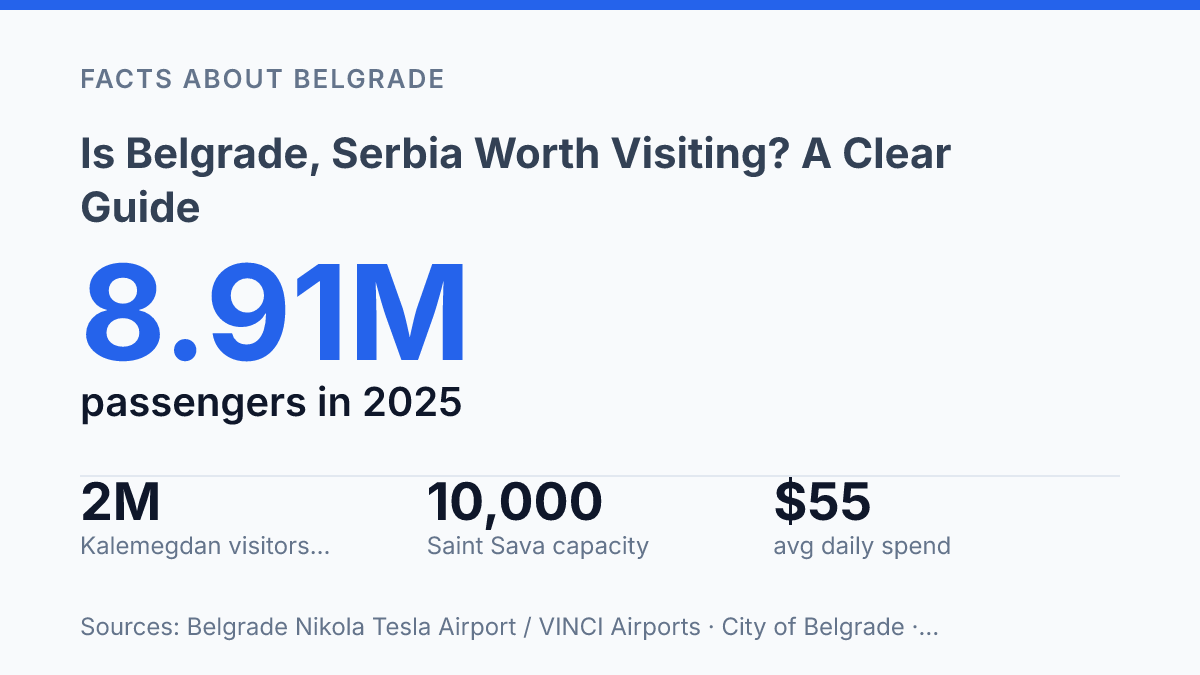
Public transport across buses, trams, trolleybuses, and the BG Train became free for all passengers on January 1, 2025, while Nikola Tesla Airport handled 8.91 million passengers in 2025. The question, then, is not only whether Belgrade has enough to see, but whether its mix of fortress views, Orthodox scale, Yugoslav history, food, prices, and access fits the kind of trip being planned.
What makes Belgrade different from other Balkan capitals
Few European capitals place their defining viewpoint directly above the meeting point of two major rivers, but Belgrade does so at the confluence of the Sava and the Danube. This geography gives the city a different orientation from more compact inland capitals: the historic core sits above the water, newer urban areas spread across the Sava, and riverbanks function as part of the city’s social and visual identity rather than as a peripheral feature. The result is a capital that often feels wider, more open, and less museum-like than visitors may expect from a historic European city.
Kalemegdan Fortress is the clearest expression of that setting because it combines a strategic military site, a public park, and one of the city’s main sightseeing viewpoints in a single place. According to the City of Belgrade in 2024, Kalemegdan covers more than 60 hectares and contains 17 preserved gates, which helps explain why it functions as more than a quick monument stop. Its position above the river junction also makes it a practical anchor for understanding Belgrade’s layout: the fortress marks the old defensive high ground, while the modern city expands outward and across the water.
Compared with Zagreb, Belgrade tends to feel larger, louder, and less orderly in its presentation. Zagreb offers a more Central European rhythm, with a tidy upper town and a calmer café culture, while Belgrade places more emphasis on late-night social life, broad boulevards, river venues, and a sense of continuous movement. Sarajevo, by contrast, usually feels more intimate and topographically enclosed, with a stronger single-axis old-town experience shaped by its valley setting.
Budapest is the more obvious regional comparison because it also has a grand riverfront and imperial-era architecture, but Belgrade is less polished and less formally monumental. Its appeal comes from contrast rather than uniform preservation: Ottoman, Habsburg, socialist, brutalist, and contemporary layers often sit close together without much visual smoothing.
That mixed streetscape can disappoint visitors expecting a consistently restored historic center, yet it is also central to the city’s character. Belgrade is most distinctive when seen as an energetic, lived-in capital rather than a curated old-town destination.
Top experiences that justify a short trip
Belgrade’s strongest short-trip case is that several of its most distinctive experiences can be reached without building an itinerary around long transfers or multiple neighbourhood changes. Skadarlija is the clearest example: the cobbled old-quarter street is the city’s best-known area for traditional restaurants, evening walks, and kafana-style music. Its value for a brief visit is not that it is hidden or undiscovered, but that it concentrates food, atmosphere, and historic texture in one compact place.
Food has also become a stronger reason to treat the city as more than a low-cost stopover. The MICHELIN Guide Belgrade 2026 lists 25 recommended establishments, including two one-star restaurants and three Bib Gourmand restaurants, according to Michelin. That range matters because it places refined dining, affordable recommendations, and traditional Serbian meals within the same short-break frame, rather than forcing visitors to choose between local character and a more formal food experience.
For daytime recovery or warm-weather outdoor time, Ada Ciganlija gives Belgrade a practical advantage over many inland city breaks. The former river island is one of the city’s main recreation zones, used for swimming, cycling, walking, cafés, and summer beach-style days. It is especially useful on a two- or three-night stay because it changes the rhythm of the trip: sightseeing can be balanced with water, shade, and open-air activity without leaving the city.
Nightlife remains one of Belgrade’s most widely recognised draws, but it is better understood as one strong layer rather than the whole argument for visiting. The reputation is built around splavs, the floating clubs and party venues, along with late-opening bars across central districts. This suits travellers who want late evenings without treating the city solely as a party destination; the same trip can still include old-quarter dining, outdoor recreation, religious architecture such as the Church of Saint Sava, or Yugoslav-history sites.
The main qualification is scale. Belgrade can feel satisfyingly complete on a short stay because many high-yield experiences cluster into a manageable circuit. A longer visit may still reward slower exploration, but it may not deliver the density of headline museums, palaces, and set-piece attractions found in larger European capitals.
Costs, transport, and practical ease for visitors
Since January 1, 2025, Belgrade has removed one cost that most European city breaks still require: tickets for municipal buses, trams, trolleybuses, and the BG Train. That change makes short stays easier to budget, especially for visitors moving between central districts several times a day rather than relying on taxis for every transfer. It also strengthens one of the city’s clearest practical advantages: lower day-to-day costs than many Western European capitals.
Accommodation, food, drink, and short taxi rides usually make Belgrade feel better value than comparable weekends in cities such as Paris, Amsterdam, or Vienna, though it should not be treated as uniformly cheap. Budget Your Trip’s 2026 estimate puts average visitor spending at about $55, or RSD 5,617, per person per day, with a typical double room around $66, or RSD 6,617.
Numbeo’s 2026 city data gives useful food-and-drink markers as well, listing an inexpensive restaurant meal at RSD 1,390, a three-course meal for two at RSD 6,000, and a half-litre domestic draft beer at RSD 350. Those figures help explain why dining and casual nightlife can be a larger part of a Belgrade itinerary without pushing the overall trip cost as high as in many Western European city breaks.
The main international gateway is Belgrade Nikola Tesla Airport, which handled 8.91 million passengers in 2025, up 6.5% from the previous year. Summer 2025 schedules connected Serbia with 116 international destinations in 40 countries, a level of air access that makes the city practical for long weekends as well as wider Balkan trips. Recent tourism patterns support that short-stay profile: January to June 2026 recorded 693,030 tourist arrivals and 1,796,583 overnight stays, with 590,921 foreign arrivals, or about 85% of the total, according to the Statistical Office of the Republic of Serbia.
Getting around the centre is usually straightforward but not always fast in the way metro-oriented visitors may expect. Many central areas can be linked on foot, while buses, trams, and trolleybuses cover broader movements across the city. The tradeoff is that surface transport can be slower and less intuitive than dense underground systems, so short itineraries work best when daily plans cluster nearby neighbourhoods rather than crossing the city repeatedly.
Who is most likely to enjoy a visit
The clearest evidence for Belgrade as a short-break fit is that recent stays averaged about 2.6 nights per arrival, according to the Statistical Office of the Republic of Serbia, which points to a city that many visitors experience over a compact itinerary rather than a long sightseeing holiday. That pattern suits a weekend city break particularly well: the city has enough eating, walking, museum-going, and evening activity to fill two or three days without requiring a highly structured plan.
Food-focused visitors are among the strongest matches because Belgrade rewards time spent around meals as much as time spent at formal attractions. The appeal is not limited to fine dining or traditional cooking; it is the range of formats, from casual grilled-food stops and bakeries to more contemporary restaurants, that makes eating a practical way to understand the city’s social rhythm. Travellers who enjoy comparing neighbourhoods through cafés, markets, and late dinners are likely to find more value here than those mainly seeking a checklist of famous monuments.
Nightlife-oriented travellers are another clear fit, especially when the trip is built around evenings rather than early starts. Belgrade’s social culture tends to run late, and this makes the city more rewarding for visitors who want bars, music, and informal atmosphere to be central parts of the itinerary. The same quality can be a weaker match for travellers who prefer quiet historic centres, early closing times, or a more orderly resort-style experience.
People interested in Balkan and twentieth-century history also have a strong reason to visit, particularly because the city reflects different political and cultural periods in a relatively direct way. Its value for this group lies less in pristine preservation than in visible layers, contested memory, and institutions that help explain the former Yugoslav space. That makes it a useful stop between regional destinations, especially for travellers building a wider route through Southeast Europe.
For first-time visitors, the verdict is positive but specific: Belgrade offers enough variety for a short first visit, especially for those who value character, atmosphere, food, nightlife, and historical context. It is a weaker fit for travellers whose main priority is postcard-perfect architecture or a dense cluster of world-famous landmarks within a small central zone.
Why the short-break case is getting stronger
Belgrade’s near-term appeal is likely to depend on how well it converts convenience into clearer visitor expectations. Free public transport and expanding air links remove two common sources of friction, but they do not make the city universally appealing. Its strongest fit is for travelers who value layered history, informal urban energy, and serious food without the pricing pressure of many better-marketed European capitals.
Those seeking highly polished old-town tourism or a resort atmosphere may find the city less immediately legible. The practical consequence is simple: Belgrade is best judged as a two- or three-night city with unusual range, not as a destination that needs a week to prove its value.
Frequently Asked Questions
Q: What is Belgrade best known for?
A: Belgrade is best known for its position at the meeting point of the Sava and Danube rivers, its long history, and its active nightlife. The city also has a mix of Ottoman, Austro-Hungarian, and modern influences that shape its architecture and atmosphere. That combination makes it appealing to travelers who want culture, history, and urban energy in one trip.
Q: How many days are enough for Belgrade?
A: Most visitors find that 2 to 4 days is enough to see the main sights and get a feel for the city. A shorter stay can cover the old center, Kalemegdan, and a few key neighborhoods, while a longer visit allows time for museums, riverfront areas, and slower exploration. The right length depends on whether the trip is focused on sightseeing or on food, nightlife, and local life.
Q: Is Belgrade safe for tourists?
A: Belgrade is generally considered safe for tourists, especially in central areas and major visitor districts. As in any large city, petty theft and taxi overcharging can happen, so standard travel precautions still matter. The practical takeaway is that the city is usually manageable for independent travel, but basic awareness remains useful.
Q: What is the best time of year to visit Belgrade?
A: Spring and early autumn are often the most comfortable periods because temperatures are milder and walking conditions are better. Summer can be lively, but it is also hotter and busier, especially around riverfront venues and outdoor events. Winter is quieter and can suit travelers who prefer fewer crowds and lower seasonal demand.
Q: Is Belgrade expensive to visit?
A: Belgrade is often seen as more affordable than many Western European capitals, especially for food, local transport, and casual dining. Costs still vary by neighborhood and travel style, with upscale restaurants and river clubs charging much more than standard cafés and bars. For many visitors, the city offers a relatively strong balance between price and experience.