
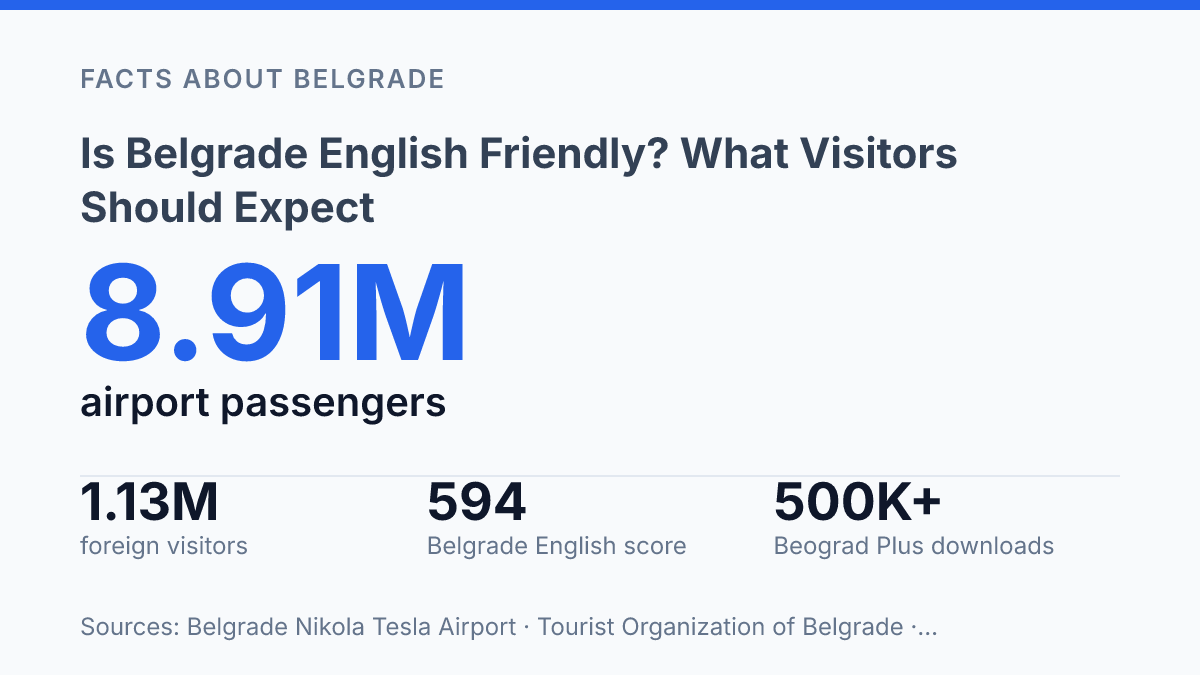
The short answer to “Is Belgrade English friendly?” is backed by Belgrade’s 594 score in EF’s 2025 English Proficiency Index, higher than Serbia’s national score of 578 and Novi Sad’s 580. That doesn’t mean every conversation will be effortless, though. The more useful pattern is where English shows up: central hotels, restaurants, airport services, younger people, and app-based tasks are usually much easier than a local municipal office or a chat with an older shopkeeper outside the tourist core.
Serbia’s own EF profile also tells a quieter story: reading scored 587, while speaking was much lower at 499, so someone may understand more English than they feel ready to use out loud. Belgrade is manageable in English, but it works best when you know where confidence drops and have a simple backup ready.
Is Belgrade English Friendly?
Belgrade scores higher for English proficiency than Serbia as a whole, which matches what many visitors notice on the ground: English is usually workable, especially in the places travelers use most. In the EF 2025 English Proficiency Index, Serbia scored 578, while Belgrade scored 594, above Novi Sad’s 580 and Southern/Eastern Serbia’s 554. So the short answer is yes, Belgrade is fairly easy for English speakers compared with much of the country, though not effortless everywhere.
You’ll have the smoothest time in central areas, hotels, restaurants, cafes, museums, hostels, airport-related services, and places that regularly deal with international guests. Younger people are also more likely to switch into English comfortably, partly because English has been widely taught in schools and is common online. In these settings, you can often ask normal travel questions, read menus, order food, check in, and solve small problems without much Serbian.
The difference becomes clearer once you compare Knez Mihailova or the area around Republic Square with a quieter residential neighborhood. In the main pedestrian and tourist zone, English menus, English-speaking servers, and staff used to foreign visitors are common. A few tram or bus stops away, you may still find friendly help, but communication can become more basic, especially in bakeries, small shops, markets, pharmacies, local cafes, or apartment buildings where staff aren’t dealing with tourists all day.
Age and service style matter too. A student working in a modern cafe may speak fluent English, while an older employee in a traditional restaurant, post office, clinic, or administrative setting may understand only simple phrases.
Formal or older establishments can also feel less relaxed about improvising in English. For a visitor, that means Belgrade is comfortable enough without Serbian in many daily situations, but outside the main tourist circuit it helps to have a few basic phrases ready and a translation app nearby.
Where English Works Best in Daily Life
The smoothest English exchange in Belgrade may be at the airport counter rather than on a neighborhood street: Belgrade Nikola Tesla Airport reported 8.91 million passengers in 2025, according to the airport, so its signage and passenger services are built for a steady flow of international arrivals. From arrivals information to car rental desks and official transport counters, short English questions are usually understood better there than in smaller, more local businesses.
Hotel and hostel reception desks are another easy zone. The English you’ll need is usually practical and repeated every day: check-in times, luggage storage, airport transfers, card payments, breakfast hours, and directions to a nearby stop or attraction. Fluency can still vary from one staff member to another, but front-desk workers are used to handling visitors who don’t speak Serbian.
At major sights, English also tends to work well enough for basic visitor needs. Around Kalemegdan Fortress, museum ticket counters, gallery entrances, and tour meeting points, you can usually manage questions about opening hours, ticket types, lockers, toilets, and guided visits.
Don’t expect every explanation to turn into a long conversation, though. A simple request like ‘two tickets, please’ or ‘is this entrance open?’ will normally go further than a detailed, multi-part question.
Transport gets easier when you use systems that reduce the need to talk at all. Ride-hailing and taxi apps let you enter your destination, see the route, and handle much of the fare information on-screen, which makes them more comfortable than negotiating with a random driver. Public transport also became free for all passengers from January 1, 2025, according to the Tourist Organization of Belgrade, covering buses, trams, trolleybuses, suburban lines, and BG Train, so ticket-buying is no longer a language hurdle.
In central areas, English is often visible before you need to ask for help. Menus, museum pages, attraction listings, Google profiles, hotel booking pages, and some street or visitor signs commonly have English versions. That doesn’t mean every small shop, bakery, or market stall will operate the same way, but for the everyday tasks most visitors handle near main sights, written English often fills the gap when spoken English is uneven.
When You’ll Need a Backup Plan
The trickiest conversations in Belgrade are often the shortest ones: a market price, a pharmacy question, or a driver confirming an address. Smaller neighborhood shops and local markets may not have staff who are comfortable switching into English, especially if you’re away from the main visitor routes. Older taxi drivers can also be harder to communicate with if you’re giving directions verbally rather than showing the destination.
Simple Tips for Easier Conversations
The fastest way to make Belgrade conversations easier is often to make your English less “English.” Speak a little slower than usual, keep sentences short, and choose plain words over idioms.
“Can I pay by card?” will usually work better than “Can I put this on plastic?” The goal isn’t to sound unnatural; it’s to remove the bits of English that are hardest to process quickly.
If you’re giving an address, make it visual as well as verbal. Serbian uses both Latin script and Cyrillic, so when possible, keep the street name, building number, and place name written in both versions.
This can help when a sign, receipt, map label, or doorway uses a different script from the one you expected. Even if the person understands English, showing the address saves time and avoids awkward pronunciation guesses.
A polite greeting does more than fill the silence. Starting calmly, smiling, and giving the other person a moment to switch into English can make shops, taxis, and cafes feel much smoother.
Some people may understand more than they feel comfortable saying, so patience helps. If someone pauses or answers briefly, that doesn’t automatically mean they’re being unfriendly.
It also helps to confirm one detail at a time. For example, ask the price first, then the pickup point, then the time, rather than putting everything into one long sentence.
If the answer matters, repeat the key number or place name back politely. Belgrade is often easier for visitors than they expect, but conversations go best when you meet people halfway instead of assuming every exchange will work like it would back home.
What changes when you treat English as a strong default
Treating English as a strong default, not a promise, is the right mindset for Belgrade. The city is getting easier for visitors: more than 1.3 million tourists arrived from January to October 2024, Nikola Tesla Airport handled 8.91 million passengers in 2025, and free public transport from January 1, 2025 removes one common ticketing headache. Still, the smoothest trips come from small preparations rather than perfect language access.
Save addresses in Serbian, keep Google Translate or a transit app handy, and learn a polite “hvala.” You probably won’t need Serbian constantly, but when you do, that tiny bit of effort can change the whole exchange.
Frequently Asked Questions
Q: Can you get by in Belgrade if you only speak English?
A: Yes, you can usually get by in central Belgrade, especially in hotels, restaurants, cafes, and major tourist areas. Younger people are more likely to speak English than older generations, so day-to-day communication is often manageable if you keep things simple.
Q: Do people in Belgrade speak English well?
A: English skills vary a lot by age and setting. You’ll generally find stronger English in hospitality, among students, and in more visited parts of the city, while in smaller shops or with older residents it may be more limited.
Q: Is it easy to use taxis and public transport without speaking Serbian?
A: Taxis and ride apps are usually easier than explaining a route in person, especially if you enter the destination on your phone. On public transport, having your stop written down or using a navigation app can save time because not every driver or station employee will speak English.
Q: Will menus, signs, and tickets be available in English?
A: In tourist-friendly areas, many menus and service counters offer at least some English, but that isn’t guaranteed everywhere. Signs and ticket machines may be mixed, so having a translation app helps when you’re outside the main visitor zones.
Q: What should I do if no one understands English?
A: Keep your sentence short, use gestures, and show the address or request on your phone. A translation app and a few Serbian basics like greetings or thank you can make a big difference when English isn’t enough.