
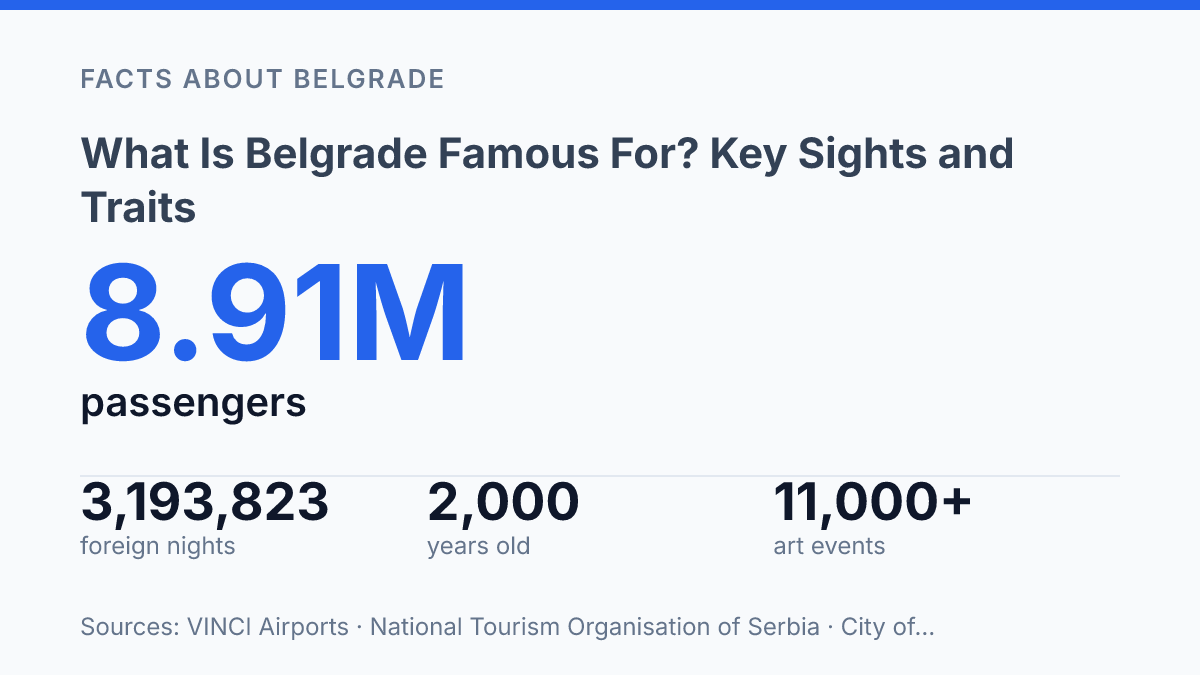
Foreign visitors spent 3,193,823 nights in Belgrade in 2024, more than in any other Serbian destination and 8% above the previous year. That growth gives the question “What is Belgrade famous for?” a practical edge: the Serbian capital is no longer defined only by its fortress or nightlife, but by the way history, access, culture, and food now reinforce one another. Belgrade Fortress, a 2,000-year-old complex associated with 115 sieges, still anchors the city’s image as a meeting point of empires and borders.
Yet the same city is also drawing larger numbers through Nikola Tesla Airport, river cruises on the Danube and Sava, and a dining scene recognised by the MICHELIN Guide. The result is a destination whose appeal rests on contrast: old walls and new routes, monumental history and everyday sociability, regional character and rising international visibility.
What the city is best known for
Belgrade’s most recognisable landmark is not a single monument but a fortress park overlooking the exact meeting point of the Sava and Danube. Kalemegdan Fortress, often discussed together with Kalemegdan Park, gives the city one of its clearest visual identities: high ground, two major rivers, and a public space that functions as both viewpoint and historic marker. The Belgrade Fortress and Kalemegdan Park complex covers more than 60 hectares and receives about 2 million visitors each year, according to PE “Belgrade Fortress,” which helps explain why it anchors so many first impressions of the city.
Historic layers that shaped its identity
Belgrade’s historic core is less a preserved period piece than a record of demolition, military engineering, imperial rule, and repair. The city changed hands repeatedly between Ottoman, Habsburg, and Serbian authorities, and those transitions often came with physical damage as well as administrative and cultural change. This helps explain why its older districts do not read as one continuous architectural museum: Ottoman traces, Central European facades, socialist-era blocks, and contemporary redevelopment often sit close together rather than forming clean historical zones.
The fortress remains the clearest evidence that geography made Belgrade strategically valuable long before it became a modern capital. According to the National Tourism Organisation of Serbia, Belgrade Fortress is around 2,000 years old and endured 115 sieges, a figure that gives scale to the city’s reputation as a contested frontier. Its walls, gates, and military terraces are not only monuments; they show how control of the old centre meant control of movement, trade, and defence across a major Balkan crossing point.
This layered identity also extends into the surrounding old town. Streets around the historic centre carry signs of different planning ideals: compact Ottoman-era urban patterns, later Central European street fronts, and buildings from the Serbian and Yugoslav periods. The result is not the visual uniformity associated with cities preserved under a single dominant era, but a more fragmented historical surface shaped by rebuilding after repeated rupture.
More recent memory is marked by the NATO bombing of 1999, when targets in Belgrade included state and military infrastructure during the Kosovo War. Damaged sites such as the former Yugoslav Ministry of Defence and General Staff complex on Kneza Miloša Street remain among the most visible reminders of that period. Their presence complicates the city’s historical profile without defining it entirely: Belgrade’s identity is shaped by conflict, but also by the civic, cultural, and everyday life that continued around and after each phase of destruction and reconstruction.
Cultural life, food, and everyday character
A Belgrade evening can still begin in a kafana, an institution that has carried political talk, family meals, and live folk music longer than many of the city’s current facades. The kafana is less a restaurant category than a social habit: tables are used for long conversations, shared plates, and a rhythm of eating and drinking that favours continuity over ceremony. Dishes such as ćevapi and pljeskavica place grilled meat at the centre of everyday Serbian dining, while rakija functions as both aperitif and marker of hospitality, especially in informal gatherings.
Food culture is not limited to tradition, however, and the city’s dining reputation has become more visible internationally. The MICHELIN Guide Belgrade 2026 lists 25 recommended establishments, including two one-star restaurants, three Bib Gourmand restaurants, and 20 selected restaurants. That recognition does not replace the older kafana culture, but it helps explain why visitors increasingly associate Belgrade with both accessible local food and more formal contemporary cooking.
Cultural identity in Belgrade is also anchored by institutions rather than only street life. The National Museum of Serbia gives the city a central art and archaeology reference point, while the Nikola Tesla Museum connects Belgrade to one of the most internationally recognisable Serbian names through exhibitions, documents, and scientific heritage. The city’s official cultural profile also points to a dense programme of theatre, exhibitions, concerts, and festivals, which reinforces the sense that daily sociability is supported by a larger institutional framework.
Architecture makes the same point in physical form. In Stari Grad, older streets and civic buildings show traces of Austro-Hungarian and Ottoman influence alongside later Serbian and Yugoslav layers; across the river, Novi Beograd is associated with socialist-era planning, broad boulevards, and large residential blocks. The contrast is not merely visual: it shapes how the city is used, with intimate central streets and expansive modern districts producing different versions of urban routine.
This mixture helps explain why Belgrade’s appeal extends beyond monuments. In 2024, foreign tourists spent 3,193,823 nights in Belgrade, up 8% year on year, the most foreign overnights of any Serbian destination, according to the National Tourism Organisation of Serbia. The figure reflects not only sightseeing demand, but the pull of meals, museums, neighbourhood contrasts, and a social culture that is unusually easy to observe in ordinary public life.
Why travellers keep adding it to their itineraries
Belgrade Nikola Tesla Airport handled 8.91 million passengers in 2025, according to VINCI Airports, which helps explain why the city has become an easy add-on to wider European and Balkan trips. The airport is the main gateway for international arrivals, and its network of 115 destinations gives the Serbian capital a practical advantage over many regional city-break options. A concession investment plan of more than €730 million also points to continued growth in capacity and passenger services rather than a one-off rise in traffic.
The rivers give the visit a second practical layer, because the Danube and Sava are not only scenic edges but working visitor corridors. River views, waterside walks, and boat-based venues make the city feel oriented toward open space rather than only toward monuments and streets.
The 2024 nautical season recorded 552 cruise ship dockings in Belgrade plus 42 in Zemun, with 603 dockings announced for 2025, according to the City of Belgrade and the Tourist Organisation of Belgrade. That volume shows that river travel is a measurable part of the city’s tourism appeal, not just a postcard image.
Belgrade also works well as a base for nearby Serbian destinations, which makes it more useful than a stand-alone weekend stop. Novi Sad is the most obvious urban pairing, while the Iron Gates connect the capital to one of the Danube’s most dramatic natural and historical corridors. The Šumadija wine region adds a rural counterpoint through vineyards, small towns, and traditional producers within reach of the capital.
A less polished urban texture remains part of the draw for many visitors. Compared with some European capitals, Belgrade can feel uneven, with grand avenues, improvised corners, riverside redevelopment, and older residential streets sitting close together. That lack of uniform finish can make the city feel more lived-in than curated, which suits travellers looking for a capital where history, social life, transport links, and regional access are encountered in daily use rather than packaged into a single visitor zone.
Why Belgrade’s reputation keeps expanding
Belgrade’s reputation is likely to become more precise as visitor patterns widen. Stronger air links, rising cruise arrivals, and growth from markets such as China are not just signs of popularity; they change how the city is experienced, with more travellers treating it as a primary stop rather than a brief regional add-on. That visibility brings pressure as well as opportunity.
A city known for layered history and informal social energy has to absorb larger numbers without flattening the character that made it appealing in the first place. The practical consequence is clear: Belgrade’s strongest identity is not a single landmark, but the balance between a heavily used historic core and a living capital still changing around it.
Frequently Asked Questions
Q: What is Belgrade best known for among first-time visitors?
A: Belgrade is best known for its riverside setting, historic fortification, and active urban nightlife. Kalemegdan, the old fortress park above the confluence of the Sava and Danube, is the city’s most recognisable landmark and a major reference point for its history. The city also stands out for a long tradition of cafes, bars, and late-opening venues that shape its social reputation.
Q: Is Belgrade a good city for history and architecture?
A: Yes. The city contains layers of Roman, Ottoman, Habsburg, and modern Serbian influence, which makes its built environment notably mixed. The contrast between older districts, socialist-era buildings, and newer developments helps explain why it attracts visitors interested in urban history.
Q: Why is Kalemegdan so famous in Belgrade?
A: Kalemegdan is famous because it combines a fortress, park, and panoramic viewpoint in one central location. It has served military and defensive functions across centuries, which gives it historical importance beyond its role as a public space. Its position above the river junction also makes it one of the city’s most photographed places.
Q: What food is Belgrade known for?
A: Belgrade is associated with Serbian cuisine, especially grilled meats, hearty stews, baked pastries, and market food. Traditional restaurants and kafanas help preserve local dining customs, while modern eateries have expanded the city’s food scene. The result is a mix of classic regional dishes and contemporary urban dining.
Q: Does Belgrade have a reputation for nightlife?
A: Yes, Belgrade has one of the strongest nightlife reputations in the Balkans. The city is known for a wide range of venues, from river clubs and bars to live-music spaces and late-night cafes. That reputation is closely tied to its social culture and the density of entertainment options in the city centre.