
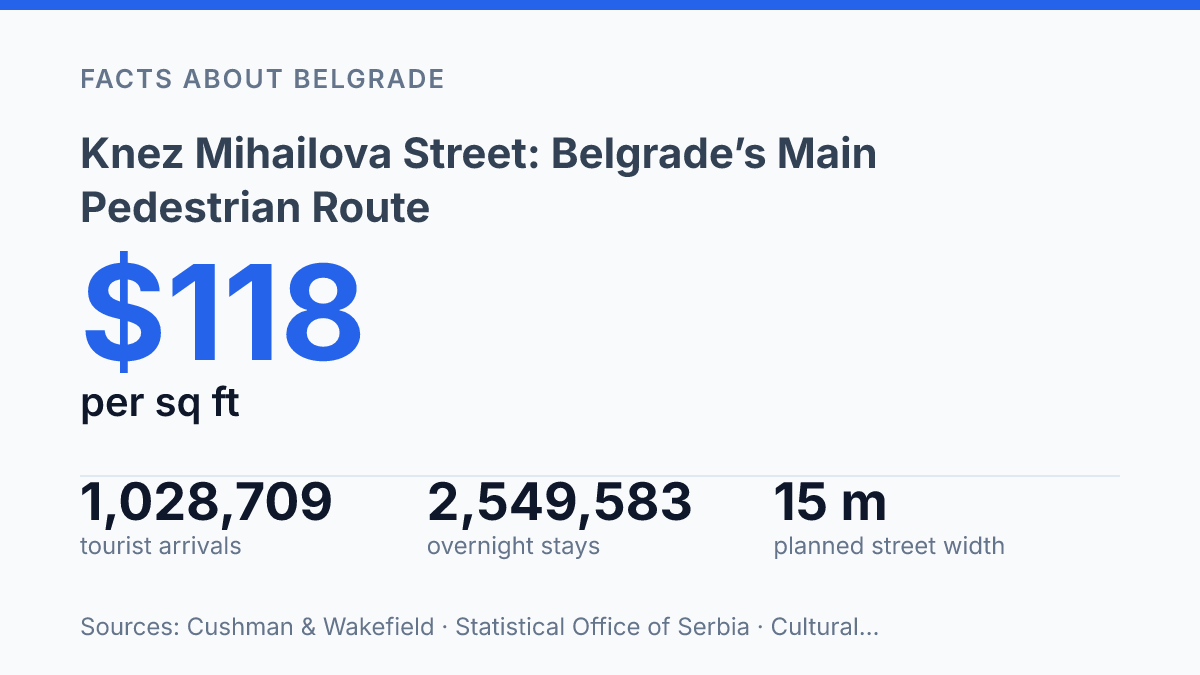
Knez Mihailova Street is not only Belgrade’s main pedestrian route; Cushman & Wakefield ranked Kneza Mihaila 36th globally in its 2025 high-street rent index, at €1,080 per square metre per year. That commercial value rests on a deeper urban role. The City of Belgrade marks its official coordinates on the street at 44°49’14” N, 20°27’44” E, placing it symbolically as well as physically at the centre of the capital.
Its line also belongs to the ridge running from Kalemegdan through Terazije toward Slavija, a route the city describes as a main traffic artery. This article examines why the street carries that weight, how legal protection shaped its historic setting, what appears along the route, and how a short walk can connect retail, architecture, public space and the approach to Kalemegdan without treating them as separate sights.
Why this street anchors central Belgrade
Belgrade’s central pedestrian axis runs not to a single monument but along the route between Terazije and Kalemegdan, where Ulica kneza Mihaila concentrates movement, shopping, and civic orientation. Located in the historic Stari Grad district, the street functions as the city’s best-known car-free corridor and as the most legible link between the commercial centre and the fortress-side edge of the old core.
Its position explains much of its prominence. At one end, the route opens toward Republic Square, one of Belgrade’s main meeting points and the setting for the National Museum; at the other, it leads toward Kalemegdan, the park and fortress area that frames the confluence of the Sava and Danube. This alignment gives the street a practical role beyond retail: it helps visitors and residents read the centre of Belgrade as a continuous walkable sequence rather than as isolated landmarks.
Tourism data also helps explain why the corridor carries such steady public activity. In January–August 2026, Belgrade recorded 1,028,709 tourist arrivals and 2,549,583 overnight stays, including 895,905 foreign arrivals and 2,189,563 foreign overnight stays, according to the Statistical Office of the Republic of Serbia. Those figures do not measure footfall on the street itself, but they indicate the scale of visitor demand feeding central locations where museums, hotels, shops, cafés, and public squares cluster closely together.
The street’s importance is therefore not only commercial. Its pedestrian-only character turns a shopping address into a public space where city navigation, informal gathering, cultural visits, and everyday errands overlap. That combination is why Knez Mihailova Street anchors central Belgrade: it is both a route through the old city and one of the clearest expressions of how the centre is used on foot.
How the street became a protected urban site
A planned width of 15 metres made the future Kneza Mihaila one of the city’s widest streets when Emilijan Josimović recast the old town grid, according to the Cultural Heritage Preservation Institute of Belgrade. That intervention placed the route within a more regular European-style street plan, replacing the older Ottoman-era urban pattern with straighter alignments, clearer plots, and a high street suited to public institutions, commerce, and representative housing. The 1870s rebuilding that followed gave the street much of its long-term character: not a single architectural style, but a layered sequence of façades shaped by late nineteenth- and early twentieth-century urban ambitions.
That architectural layering explains why protection applies to the street as an urban ensemble rather than only to isolated monuments. Buildings such as the Serbian Academy of Sciences and Arts show how cultural institutions became part of the street’s civic identity, while the Hotel Majestic represents the interwar period’s more modern commercial architecture.
Their value lies partly in individual design, but also in how they hold the scale, frontage rhythm, and public-facing character of the route. In heritage terms, the street functions as a preserved urban composition, where façades, parcels, sightlines, and ground-floor use all contribute to historical continuity.
The legal basis for that approach is formal, not merely symbolic. The area was listed as a spatial cultural-historical unit in the 7 April 1979 issue of the Official Gazette of the Socialist Republic of Serbia, and Serbian conservation authorities classify the wider Knez Mihailova area as cultural property of exceptional importance.
This status protects the inherited appearance and urban structure, but it also constrains how much new construction, signage, façade alteration, or public-space redesign can change the street. The result is a managed balance: the route can remain commercially active, yet major changes must respect the historical framework that made it central in the first place.
What visitors encounter along the route
Cushman & Wakefield ranked Kneza Mihaila 36th globally in its Main Streets Across the World 2025 index, a retail-rent signal that helps explain why the pedestrian zone feels commercially dense as well as historically formal. Shopfronts, international and local retail, cafés, bookstores, small galleries, and service businesses sit close together, so the route functions less like a single shopping strip than a layered public corridor where errands, browsing, meeting, and sightseeing overlap.
Several stops give the walk its architectural and institutional texture without pulling attention away from the street itself. The French House is one of the recognisable façade landmarks along the route, while the National Bank of Serbia adds a more formal civic presence nearby. Toward the upper end of the pedestrian flow, access to Kalemegdan Fortress gives the street a natural sense of release, as the commercial corridor opens toward one of Belgrade’s best-known historic open spaces.
At street level, the experience is shaped as much by small urban details as by landmark buildings. Benches and widened pauses in the paving allow short breaks, while decorated façades, balconies, cornices, and ground-floor windows create a continuous visual frame above the retail signs. This mix matters because the street is not only crossed on the way to somewhere else; it is used for slow walking, waiting, informal conversation, street performance, and window-shopping.
Foot traffic is part of the street’s economic strength, but it also changes the feel of the central stretch during peak periods. Warm-weather evenings, weekends, and holiday seasons tend to make café terraces and shop entrances more active, concentrating movement around popular storefronts and seating areas. The result is a pedestrian route that can feel animated and sociable at ordinary times, yet compressed when groups, shoppers, and tourists move through the narrowest sections at once.
Best way to see it on a short city walk
Begin at Republic Square, continue along Knez Mihailova Street at an unhurried pace, and finish at Kalemegdan Park, where the paved city route opens into greenery and fortress-side viewpoints. This sequence works well for a short first walk because it follows the natural flow of central Belgrade without requiring detours or transport planning. The route is simple enough to complete as a focused walk, while still leaving room for pauses at shop windows, cafés, courtyards, or side streets.
Because the street is pedestrian-only, it is especially easy to combine with nearby sights in a compact visit. The absence of through traffic makes the walk more flexible: stopping, crossing from one side to the other, or reversing direction does not require the same attention as on surrounding roads. For a short itinerary, this matters because the street can function as both a destination and a connector between the square and the park.
Timing changes the character of the walk more than the route itself. Daytime is better suited to browsing, errands, photography, and reading the street’s façades in clearer light. Early evening tends to shift the emphasis toward café tables, meeting points, and slower social use, especially when the weather supports outdoor seating.
The same short route can therefore feel efficient in the middle of the day and more atmospheric later, although busier periods may make the walk slower. For a first visit, allowing time for one stop along the way usually gives a more accurate sense of how the street functions than treating it only as a passage between landmarks.
Where the pedestrian route could expand next
Belgrade’s next planning step may make the street less like a single destination and more like the spine of a larger pedestrian district. In May 2024, the city announced plans to connect Kalemegdan and the central pedestrian zone through Pariska, Gračanička and Uzun Mirkova, with a new square, promenade and pedestrian area.
If carried through, that would extend the logic already visible in the protected zone: commercial use, heritage control and everyday movement are being managed as one connected urban system. The practical consequence is that future visits may begin to feel less focused on one famous high street and more on a continuous civic route between the fortress, Republic Square and the older core of central Belgrade.
Frequently Asked Questions
Q: Where is Knez Mihailova Street located in Belgrade?
A: Knez Mihailova Street is in the historic Stari Grad district of Belgrade. It runs through the city centre and is one of the best-known pedestrian corridors in the capital.
Q: Why is Knez Mihailova Street so popular with visitors?
A: It is Belgrade’s main pedestrian and shopping thoroughfare, which makes it a focal point for walking, shopping, and sightseeing. Its central location also places it close to major landmarks and public spaces in the old city core.
Q: Is Knez Mihailova Street only for pedestrians?
A: Yes, it is primarily a pedestrian street, which means vehicle traffic is restricted. That pedestrian design supports heavy foot traffic and makes the street more suitable for shopping and casual sightseeing.
Q: What is the official name of Knez Mihailova Street?
A: The official name is Ulica kneza Mihaila. The shorter English form, Knez Mihailova Street, is commonly used in travel guides and maps.
Q: What kind of area is Knez Mihailova Street part of?
A: It is part of Belgrade’s historic centre in Stari Grad. That setting gives the street a strong civic and commercial role, linking retail activity with the city’s older urban fabric.